October 15, 2013

The Eternal Flame


The Eternal Flame
by Cynthia D. Witherspoon

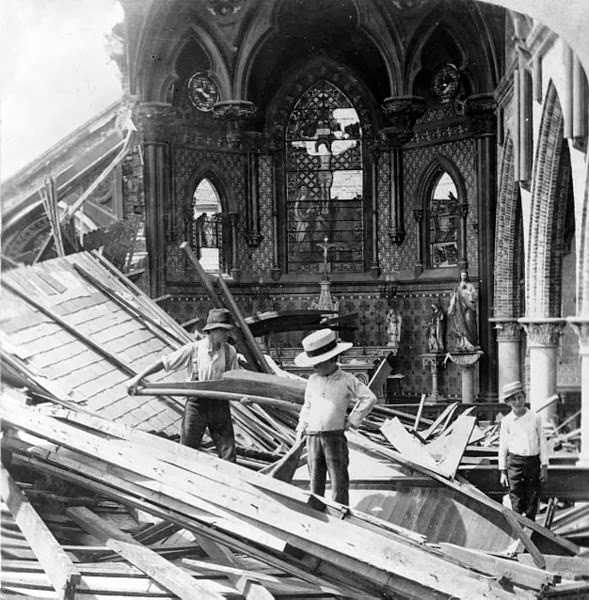
God abandoned us on the day of September 8, 1900. Those possessed with their grief shouted out among those of us who remained, screaming over their Bibles that we would see the end of the world in less than an hour's time. Yet their hour of supposed deliverance passed into the next, and all I could see were the wretched and swollen bodies of those less fortunate than I. Or perhaps they were the fortunate ones, for they were no longer present to witness the aftermath of the worst storm ever experienced by man on Galveston Island.

I picked my way through the mounds of fallen beams now serving as grave markers for those we hadn't found to go towards the town center. They shifted beneath my steps, threatening to drop me beneath their heavy weight where the darkness could swallow me whole and I would no longer be forced to deal with the weight of our plight. But I was not so lucky; for they stayed solid despite their movements until my feet dropped down to the cobblestones of the town center.

It was the first place cleared of the wreckage so that men could meet. Planning our glorious revival, they said. Yet these brothers of mine were crazier than those feverish with their religion. Galveston could be rebuilt of wood and nail, that was certain. But a return to our days of glory would never be. There was too much fear now. Too much damage to ever resemble what we once were.

“Mr. Grant, over here, sir!”

I glanced up to throw a wave at Mr. Joseph Irwin, the new mayor of our town. The old one was laying at the top of the putrid pile that he and the others had gathered around. It was my neighbor who spoke up with the disgust that only a Catholic could feel at what was being purposed on this horrible day.

“You can't be serious, Mr. Irwin!” George Smith grabbed the mayor's arm to capture his attention. “How will their souls know where to go, if they are to become nothing more than...”

“The very same way they knew when we threw them into the gulf.” Mayor Irwin pulled his arm free. “If we are ever to rebuild, we must clear them away, George. I am sorry...”

“Sorry? Sorry for doing the Devil's work?” Smith snorted as he turned towards me. “Tell him, Grant...tell him that he can not go through with...”

His words faded into the creaking of wagon wheels coming ever closer to our location, and I fear I had to put my sleeve up to my nose to cover the stench. The bodies of our comrades, our families, and our children had become a blight most dangerous. It had been three days since the storm ravaged Galveston. Three days spent gathering our dead and giving them a burial at sea most becoming of the men and women of port. Yet now, God continued to mock us with each body that washed ashore on His tide. Perhaps the Jesuits were right. Perhaps we were all damned. But at this time, we had no other choice. If the rest of us were to survive, there was only one action to take.

“I can't argue, Smith, for if you wish to continue to live, then we must do something. This is just as good as any.”

“Then it shall be you that will light this hellfire. I'll have no part in it.”

I considered the man a good friend. Sheltered him through the storm in the underground bunker I'd built after my childhood filled with the wind storms that often ransacked my home in Kansas. Yet, he turned away from me. From his beloved Galveston as Mayor Irwin handed me one of three torches. He took another, and the other was passed to the only priest who survived his God's wrath. Mayor Irwin nodded that we should begin. I stopped, staring at the flame in my hands before looking around at the crowd that stood on the shifting beams to watch us. They were the very same that had been screaming to the heavens for their deliverance. Yet now, they were silent in their prayer.

I moved then, closing my eyes as I touch the torch to each bloated hand or head within my reach. I couldn't bear to look at them, for if one face became recognizable, then I would have dropped the flame and ran. Joined Smith in his coward's station amongst the ruins. The air became putrid, rich with the sweetness of death. It wasn't until the crackle of their clothes and the flesh began to melt from bone that I stepped back with the others.

Watching the eternal flame that would burn through the days and nights. The light of hell had come to the shores of Galveston, and here, it would be fueled by the souls of those we had known. Loved. Laughed with. Lost forever from God's grace and our own remembrance as their ashes drifted down to blanket what was left of this unholy place.

* * *

Cynthia D. Witherspoon’s publication experience includes “Something’s Got to Give” (2004-2005 The Concept) as well as “Chorus of the Dead” in Whortleberry Press’ short story collection entitled It Was a Dark and Stormy Halloween. For 2012, her accepted stories include “The Necklace” (No Rest for the Wicked), “Angel of Destruction” (Dark Tales of Ancient Civilizations), and “Black Widow” (Nasty Snips II). Under the pen name Cynthia Gael, Witherspoon has had several stories published with K.G. McAbee. Her first novel collaboration with K.G. McAbee, Balefire and Moonstone, reached #65 on Amazon.uk’s Love and Romance Bestseller List in November 2010.

Where do you get the ideas for your stories?
Anywhere and everywhere. I can see a news article or be walking through a parking lot. Inspiration can hit you at anytime.

What inspires you to write and keep writing?
My love for the art of writing. There's nothing like creating new worlds and people to go in them.

What do you think is the most important part of a historical fiction story?
What they tell us about human nature. We all think of history as dates and names, but we forget those names had lives and loves attached to them.

What do you think is the attraction of the historical fiction genre?
There is a fascination with the past, I think, that goes hand in hand with our need to understand our human natures.

Riley Forkluck Davis


Riley Forkluck Davis
by Rigina Gallagher

Riley walked at a forward angle down Main Street, his neck and head craning forward to the point of his long, cavernous nose. His suitcase was raised to chest level, just under his craning chin, so that it appeared to be held up in an effort to either protect or hide himself.

Walking past the dirt-caked buildings on Main Street, he came to a stop by a water trough set up for the horses while their owners were in Sal’s Saloon. As he did so, a horse jostled down the street pulling the slump of a starving, maddened family. Frontiersmen as the history books would call them, luckless fools as they were called now.

During a certain time in his life years before, Riley would stare after the frontier horses. He concluded that the horses knew what the families could not bring themselves to see. He supposed the horse, after tugging the heavy wooden barrel into the desert, after carrying her small rotting carcass without food and water, realized its course was unnatural. That was what made them adopt a ghostly expression in the eyes, what made some horses just lay down in the soil and die. But then there were others, others (like this horse here) that managed to pass through towns alive. Some, instead of choosing to die rather than continue, continued until they died. Shortly after that observation, Riley stopped looking at horses.

So he did not notice how, with his craned neck, and dropped head, and cavernous, sloping nose, and pocked, hollow, sagging cheeks peeking out from his plastered-on straw hat while he hid behind his raised valise at the trough, very closely he resembled the frontier horse passing him by. Right now, he was too occupied staring into the trough waters. The desire to seep under its surface and go into a long slumber flashed across his mind.

But because Riley was a drifter, not a man of action, he realized it would be easier and less of a radical disruption to get a drink than to drown. He knew what awaited him inside the door, and for a moment he wished to turn around and go back to the trough, but for some whim unknown to him he disregarded the idea with a wince and held his breath as he entered the dark wooden bar.

The name “Riley!” was fired through the air with one-third contempt, one-third accusation, and one-third welcome, the last inflection constructed by the bartender because Riley was business, and business was always welcome. Riley, gripping his valise tighter and shooting his gaze to his feet, made his way to the stool at the farthest left corner of the bar. It was the best view one could get of the window, as it was the closest one could get to the glass that spewed the outside in while still not having to turn to face the bar counter.

“What da ya want? Your scotch?” The bartender had already lifted the bottle from the dark mysterious pit under the counter.

Riley’s eyes still searched the window light as he echoed back “Yeah. A scotch.”

A few moments of silence elapsed as the bartender filled the glass and set it before Riley. One could hear the turning of gears in Riley’s head and the silence of the absolute concentration of the bartender on the glass. Suddenly, a woman only Riley saw sauntered by with a parasol in a white, green trimmed dress. Riley looked away from the window with a wince just as the bartender moved away from the filled scotch glass.

“Hey, Riley.” The disembodied voice came from Ned.

People were always kicking Riley’s valise. Sometimes they didn’t mean too, a man with a cane would be walking by with his lady and accidentally rack the case. “Sorry, old chum,” he would say as Riley continued to look after him until the gentleman disappeared from view or an old lady cast a suspicious eye in his direction. Other times when townsfolk did it, it was intentional. (Riley had been to so many towns so many times (on account of his poor success) that now most of the people in any given town in the western states knew him or of him.)

“You got any more of those oxen tail strings?” continued Ned with a hawking laugh. Riley was about to answer No, sold the last one yesterday even though he still had a full inventory in his valise. But then he realized that whatever he said would be turned against him in mockery, and Ned was sitting off to the wall some distance behind him, so he, Riley, did not necessarily have to answer. Not like if someone was siting next to him, thought Riley.

Riley did lower his gaze under his hands, clapped on the bar table, and followed the peeling cloth patterns of his valise. He got lost in them. He had not always been a salesman. No, Riley remembered back to when he was in college.

* * *

In May of 1879. Riley was one of the three-hundred-and-seventy-eight black globular forms clustered on the hot summer lawn of Bowdoin College. He was one of the black garbed figures off in a cluster to the front left of the field, close in front to podium and to the Maple trees and pines that fenced the open field. He stood, his form slightly hunched as he looked into his feet. Unlike most of the other twenty-one year old men, Riley did not extend his face in an elastic grin at the president. Nor were his eyes clinging about thirstily, seeking out certain faces in the crowd, the faces of his friends-the brothers-he would never see again. His face held no recognition of time at all. It was frozen-for the moment outside the realm of time. His taut skin, brought in by ruminating, nervous lips into a cloak of dried tenacity, transformed his cheeks into sea cliffs.

It was not until the president called his name and Riley looked up onto that blank, wide-open stage that he realized he was graduating.

* * *

Had a wife too. She got married in a white dress with green lining on the sleeves and about the bodice. Her name was Lena, and she was the most beautiful woman Riley had ever seen. At the ceremony, everyone, including Riley’s uncle Billy, said they would make a great pair. The world better watch out, because the two of them could do anything together. Riley’s uncle Billy was a quiet man who spent most of his time at parties in different corners. Billy had hawks’ eyes and Riley was convinced that Billy did not like him. His past and how he got enough money to wear a different set of gold cufflinks for every occasion (no one had ever seen him wear the same ones twice, and one pair even had diamonds the size of Riley’s pinky nail in them) were unknown. Riley had remained subconsciously aware that uncle Billy did not like him, or anyone for that matter, until two hours before his marriage to Lena when Billy had caught him in the dressing room tying his green bow tie that was to match the embroidery on Lena’s white dress.

Billy didn’t knock. He simply opened the door, which from Riley’s view in the mirror resembled Dracula opening his coffin, and quietly, composedly, walked into the room. He said nothing. He smoked his cigar and let his eyes loosely touch on everything in the dark closet of a room: the ceiling, the floor moldings, the carpet, the space between the chair legs. It looked as if he was in a dream and could have just as easily been perfunctorily scouting out the bathroom. After he had finished his reconnaissance at the other side of the room, he said with no warning and to no one in particular, “You two will make a good team.”

Riley smiled, but knew that Billy did not see because Billy’s back was turned to the mirror.

Riley was able to get in a quick “Thank you,” as Billy approached the door. Billy nodded with the rim of his hat and disappeared.


* * *

But there had been no children. The doctor quietly came out of the room holding his hat in his hand, eyes wet. Instead of finding one dead corpse, Riley found two. Lena and the baby had died in childbirth. The first thing Riley did was run down stairs and reach for the bottle of gin under the fine china cabinet (the one Lena’s brother Ramon had given them for the wedding), and had been doing it ever since.

The worst part came later, when they carried Lena and Abigail (that was what Riley and Lena had agreed to call the child if it were a girl) into the parlor. Riley had walked right into the parlor (he did not know that they would be placed so close to the entranceway) and saw them dead and thought Abigail plastered on top of death. (Ten years later when Riley came across a girl named Abigail in a white dress with pink ribbons in her hair he gave her mother an extra spool of pink yarn at no extra charge and found himself on the verge of tears for no explicable reason as he made his way down the road) Then, Riley was left with the haunting loneliness that inhabits the hollow corners of an empty place that should be filled. Lena was not there anymore. Only empty frames were. After three days and two nights he could not take it anymore (he heard voices in the walls) and walked out.

He could not go back to the house. He could not go back to any house. He did not know how long he would have to remain outside, but he just knew that right now he could not go back into any house. So, interim (until he regained the ability to wipe his feet on a door mat) he took a job as a traveling housewares salesman.

Riley could say that he had no home anyway, that he could never go back to a home anywhere because being in one alone would remind him to much of being alone without Lena, and that getting married again was unthinkable, but he didn’t. He never said anything.

Last Tuesday, Riley had woken up on his birthday to the fact that he was fifty-two years old and had been a salesman for thirty. It came to him that he was too late to start out on a new career. In fact, most men that he had seen his age on his rounds had already retired and were waiting out in their porch rockers to die.

It was in such a state that Riley had wandered into the streets of Sans Palos like a horse, which knew its fate was sealed and its end near, wondering if all the toil had been worth anything.

Off in the back, at a small table, the wind of a conversation between Ned and Fin could be heard.

“I wonder what his son thinks,” Fin pondered softly.

“Ole Riley, with kids?” laughed Ned.

Riley, awoken from his rambling thoughts, slammed his empty glass on the table, and keeping his eyes fixed on the space where the door met the window light, he walked out.

* * *

Riley sat on a log beside one of the side roads, staring into the puddle in front of him.

“Hey Mister,” piped a small voice.

Riley raised his head to a silky mat of blonde shinier than the hide of a newly brushed black stallion and as light as ribbon. Riley, caught off guard, realized the head was a good four feet under his own.

It took Riley a few moments to right himself and adjust his sight to the image.

“Yes?”

“You wouldn’t happen to know where I could get a line of twine, would you?”

The child appeared to have in his left hand a stick with a thin clear line attached to the end, and in his right more of the thin clear line attached to a small, sharp fishhook. Riley processed that the boy had broken his fishing pole line and was searching for a way to fix it.

For a split second Riley was overcome with a revelation. He stared not at the boy or himself but at the lighted space between them, which the side of the boy touched on. There was something about the boy, how his conversation was only of fishing poles and watering holes; how it wasn’t about a person, and how it wasn’t about anyone in particular at all. It was completely centered in the present. No past at all. He didn’t even know who Riley was. He had no idea about his misfortunes and failures. To him, Riley was not a failed human being. He was just a man.

“As a matter of a fact I do.”

Riley kneeled down to open his suitcase on the ground. With alacrity he flipped up the locks and reached into the yellow, stale-breathing insides, into the back left corner, and pulled out a spool of oxen tail thread from a neatly organized group. Then, he reached into the top pocket compartment and took out a pair of cutting scissors.

“About how long?” Riley asked as he unspun the spool.

“About there would be good mister,” responded the boy, gesturing to the spot on the line of unwound string. Riley cut near his fingers and replaced the spool and scissors in his bag, closed it, stood up, and handed the string to the boy.

“Gee, thanks. I woulda never thought someone would have had string sitting around in his suitcase and all.”

Riley smiled as he watched the boy tie the string to the end of his stick.

“About where do you go to catch ‘em? Are there any good fishing holes around here?”

“Yep. We go over to Marlin’s Pier. It’s a mile or so down there,” the boy turned to point to a place down the river behind him.

“Ya get anything good?”

“Yeah. There’s trout and sometimes even fluke in there. You should come sometime mister, if you like fishing and want something good to catch.”
Riley looked past the boy into the spaces of the trees.

“The name’s Davis, son, and do you know there’s a better way to carve out a fishin’ pole then that?”

“No. This is the only way I ever learned.”

“Here,” Riley took out a leather handled blade from his suit pocket, one of many he had stocked in his suitcase. He then picked up a large branch near his right foot, “I’ll show ya how to make it and you can take me to this fishing place you’re talking about. I could use some fishing.”

“Sure,” responded the boy and Riley followed him into the pine droves of the forest.

Later that evening, Riley could be seen walking off from the Main Street of Sans Palos, holding his valise at knee length, although still bent forward, but in a dreamlike daze in the warm, red-orange and yellow hearth tones of the setting sun.

* * *


* * *

Sheriff Tim and Nathan were splitting logs down the street, across from A.S. and Co. Bank, but Nathan had since stopped and stood against his axe to watch Riley and his valise go off.

“How’s Maggie and Charles, Tim?”

“They’re alright,” Tim responded, lowering the ax into the log. “Maggie’s had a bit of a cough, but she’ll be out of it soon.” Tim lowered the ax and wiped his forehead on the already soiled cuff of his sleeve.

“Why do you ask?”

“Oh, we were just talkin’ about ol’ Riley there,” here he gestured toward the distancing Riley with a flick of his neck, “at Sal’s today.” As he paused they both stood looking out after Riley, “And I’ve just got to say I sure am glad ol’ Riley never had kids.” He paused again, his eyes locked steadfast on Riley, “Would’ve had ‘em all for the wrong reasons.”

* * *

Rigina Gallagher is studying literary arts at Brown University. Her previous work has appeared in the magazines Fade, On-Verge, and Connections.

What do you think is the most important part of a historical fiction story?
Personally, I am drawn to a piece of historical fiction if the story transcends time and place. If a character experiences feelings of love and despair, or is involved in universal situations, I think the time period of the story takes on a fresh meaning for the reader.

Where do you get the ideas for your stories?
Really from people's flaws. This was strange to me because I always thought I would write about characters I would admire. But somehow it seems that, like that one dirty spot on the wall, whatever it is about the "flaw" that bothers me, bothers me until I can channel all it out into a piece of writing. Usually the story then builds up around a character.

Paganini's Secret


Paganini’s Secret
by David Wright

Draco Donatello entered the director’s office visibly distempered—shirttail loose, bow tie missing, wine stains on his high-necked, starched-white collar. The director felt his afternoon yogurt turn immediately sour in the pit of his formidable stomach.

“Herr Donatello, what on earth has happened to you?”

“You will not believe it. I dare not say.” Draco plopped himself into one of the director’s aging velvet chairs and began, with great dramatic effect, to dab the sweat from his forehead.

“But the concert! You have only a few hours to prepare. Are you ready?”

Draco waived away the question with a flurry of his pink pouf. “There will be no concert tonight nor ever. Can you not see my state of mind? I am harrowed, vexed, perplexed and aghast all at once. No, no. A concert now is out of the question, especially not after what I have just seen.” Draco’s eyes grew to the size of ripe grapes.

The director waited patiently, but Draco said no more, returning to the foppish task of dabbing his perspiration with his pink pouf. The director thought of the money he had already invested in this temperamental artist and the sour feeling in his stomach blossomed into a full-blown bellyache. He was merely Munich’s Senior Concert Master and could not afford to lose his temper. Herr Donatello, on the other hand, was a delicate genius and an Italian. He could do what he liked.

“What have you seen, Herr Maestro?” the director asked carefully, his voice as gentle as the e-string on Draco’s Stradivarius.

“Magic! Wonders beyond your wildest dreams.”

And thus began his story.

* * *

I arrived at the house of my friend Paganini just before noon. My carriage had bogged in the mud making me almost a full hour late. And yet apart from the grim-faced servants flanking the doors, the parlor of Paganini's luxurious Munich townhouse was completely empty. I beat the rain from my beaver-felt, top hat and advanced on the lonely figure in front of the hearth. There the noble Paganini sat quietly brooding on his lush, rosewood sofa, smoking an opium pipe and sipping mulled brandy. My heart went out to him.

“Blessings be on you, my dear friend,” I said by way of greeting. Paganini looked up from his pipe, slightly bemused. Despite the many years which had passed since our last meeting, he looked not a day older.

“I'm surprised to hear you wax so holy in the presence of the world's most famous devil.”

“Balderdash. You are a sinner, yes, but no more the devil than I. In fact, you are much better than most. Perhaps your only true sin, apart from the occasional smoke of that wretched substance, is being blessed by God with the fingers of angels.”

“Or devils.”

“Pff.”

Paganini grimaced as if in pain, put a brandy in my hand, and motioned for me to sit in one of the opulent armchairs (upholstered in authentic Indian silk) that were before him.

Ever since Paganini had first graced the European concert stage, he had been a sensation. His command of the violin, viola and cello were unparalleled. He was a genius among geniuses, and hated for it. It wasn’t long before the rumors began—secret nocturnal meetings, pagan rituals, occult practices. In the parlors of the rich and indolent, foolish women and spiteful men were saying that the great Paganini had sold his soul to the devil in exchange for his incomparable musical talent. It was balderdash, of course. Could they not see that this man, this great man, was simply blessed by God?

“You were always a good friend, Draco,” Paganini said sadly. “And, as it appears, my only friend. But now, I'm afraid, I have to ask you in the name of friendship to break your honor as a gentleman. For I have a secret truth that cannot be spoken to anyone, but must be covered up with more lies.”

“What secret, my friend?” Draco felt his heart sink with doubt. Could there be any truth to the spiteful lies?

Paganini paused a moment in silent contemplation, sniffing his brandy, and then all at once made up his mind. “The great Paganini that you see here before you is a robot.”

I shrugged. I had not heard the word ‘robot’ before and supposed it to be some foreign term that he had picked up on one of his many travels abroad.

Paganini smiled again. “An automaton, a machine—like some elaborate wind up toy or that ridiculous old grandfather clock that paces over there in the corner.”

“You are speaking metaphorically, of course.”

“No, sir. I am speaking quite literally.” Paganini put his brandy down on the rosewood table before him and began to unbutton his tunic.

“Really, Niccolo. I don't think that's quite necess-- Good heavens!”

I cannot relate to you in words the sight that was before me—half-man, half-machine. My brandy dropped to the floor, the crystal shattering into a million pieces and the wine spilling into an irregular stain on the Persian rug's finely knitted mosaic of the woman at the well. Paganini shook his head and buttoned up his tunic. When I had sufficiently recovered and my glass of brandy had been replaced, Paganini began a tale of the most baffling and remarkable nature.

Paganini came, as it turned out, from a far away place and a far away time where men and women live like angels or gods with power over life and death and all creation—a place where there is nothing left to discover, and nothing left to do but to watch the ticking clock and wait for oblivion. While some of Paganini's kind were content to live out this destiny of devils, Paganini was not. Stripping himself of almost all his powers, he became pure thought, and traveled backwards through time. Because of the indomitable rules of the universe, the speed of light and the fabric of space, only pure thought can travel through time, or so he explained.

After sampling the minds and madness of the ages, Paganini possessed the mind of a poor Italian farmer, his own Geppetto so to speak, on the man's sixtieth birthday. He possessed his aging fingers and brain with knowledge and skills far beyond the sages of his time, to build a boy, the boy that God had never given him, out of ceramic, iron and glass. He labored without eating or sleeping for three days, and when he had finished, Paganini (although that was not yet his name) was born anew into a perfect body that would never age and would always be subject to his will. The robot boy stayed with his new father for five years, faithfully playing the part of a model child and giving his earthly father nothing but happiness in his final days. When death at last claimed the old man, the robot boy set out into the world to start his new adventure.

On the road to Venice, he came across an unfortunate fellow who had been thrown from his horse. His back was broken and he had been lying in the mud for a day and half. With his dying breath, the man whispered his name, “Paganini.” The name meant nothing to the boy but the man's clothes were well crafted, his perfume pleasant. The boy thought he might like to have such a life, to own such things as fine clothes and perfume. So when the boy was sure that Paganini was dead, the boy assumed his clothes, his stature and his face, and headed into town.

“Paganini!” A man was yelling from somewhere in the crowded train station. “Paganini!” Suddenly, the man became visible—short, round, bald—as he burst out from behind the mass of regularly sized Venetians and travelers.

“Yes, I am Paganini.”

The man ran up to Paganini and grabbed his arm. “Come on. The train is leaving.” The man talked incessantly about schedules and rehearsals and other things about which Paganini, in his new limited form, knew nothing. Paganini listened, his recording device working while his higher brain functions concentrated on more important events like the rapid passing of the canals, trees and buildings outside his window. He had never been on a train. The speed was exhilarating.

“Do you understand?”

Paganini replayed the recording as he carefully regarded the short, fat, bald man whose name was Ralpho. “The train will arrive in Paris at 6:00, and I am to perform at 7:00.”

“Good.”

“May I ask what I am to perform?”

Ralpho looked at Paganini as if he had suddenly transformed into the antichrist. “The Tchaikovsky! You can't go changing repertoire at so late a date. The brochures have already been printed. Contracts have been signed.”

“The Tchaikovsky will be fine.” Paganini nodded knowingly, although in actuality he knew nothing of Tchaikovsky or his music. Fortunately, his human father had known enough about music to bang out a few folksongs and hymns on the guitar.

“Do you, perchance, have the score?”

Ralpho squinted in apparent agony, as he dug through his bag. “I might have it here somewhere. I don't know why you want to look at it now. You've played it a thousand times. Here it is.”

Paganini looked at the cryptic notations, placing his finger on his lips and again nodding. He was sure of one thing. This was not guitar music. “I'm sorry to trouble you, Ralpho. One last question—What instrument will I be using?”

Ralpho began to laugh as tears welled in his eyes and streamed in unison down either cheek. A moment later, he was running down the train aisle, pulling at his hair and mumbling curses into the air.

By the time the train arrived at the Paris terminal, a shaking Ralpho had recovered enough to lead Paganini to the concert hall in the heart of Paris. Promptly at seven, a Stradivarius was placed in his hands and Paganini played the Tchaikovsky Violin Concerto Number One with flawless, robotic perfection.

And the rest, as they say, is history.

* * *


* * *

An hour after Draco Donatello had finished his remarkable story and left the concert hall, the director was still in his office staring at the empty velvet chair in front of him, his eyes larger than grapes, perhaps the size of new plums. He heard some words in Italian and looked up. Paganini was standing in the doorway with his diminutive but portly manager, Ralpho.

“The Maestro wishes to know if you are well,” Ralpho said. Ralpho spoke German with a thick Italian accent. Paganini spoke no German at all.

“Yes, yes. I am quite well, thank you.” The director stood up, slightly embarrassed. “Please come in and make yourselves comfortable. Can I get you some refreshment?”

“Opium?” Ralpho asked immediately.

The director cringed. “No, I’m afraid not, but I have a lovely brandy.”

The Maestro and his manager exchanged a few fleeting words in Italian and then sat down in the director’s aging velvet chairs. “No, thank you, but the Maestro wishes to know why you have sent for him early. He is not due to perform for another week,” Ralpho continued.

“Ah, yes. Well.” The director put his fingers together thoughtfully. “Draco Donatello is, well, ill. I’m afraid tonight’s concert will have to be cancelled unless…”

“Unless the Maestro can take his place? Tonight? Why, that is preposterous.” At this exclamation, Paganini touched Ralpho’s arm ever so slightly. Ralpho’s indignity vanished like a gentle spring Zephyr. “The Maestro agrees. What is he to play?”

“It is a new piece.” The director handed Paganini a weighty manuscript. “But of course the Maestro is welcome to play whatever he likes.”

Paganini flipped through the score with disinterest and then nodded.

“The Maestro will play the piece,” Ralpho interpreted.

The director laughed. “So it is true.”

Ralpho and Paganini exchanged a quick glance. “The Maestro would like to know what you mean by that. He does not enjoy being laughed at.”

The director cringed. “Oh, my good sirs, please forgive me, but I am not laughing at the Maestro. It was just something Herr Donatello said. It is of no consequence. I believe he was a colleague of the Maestro.”

“Yes, but they had a bit of a falling out of late. The Maestro would like to know what his colleague is saying about him behind his back.”

“Oh, no. It is nothing like that. Herr Donatello speaks quite highly of the Maestro. He told me about his amazing ability to memorize an entire concerto at a single glance.”

“Yes. The Maestro is an unparalleled genius. What else did Draco Donatello have to say?”

“It is nothing, as I said. Herr Donatello is quite ill.” The director felt the sweat bead on his brow and reached for the pink pouf that Draco had left on his desk. He felt the Maestro’s eyes bearing down upon him and knew he must confess. “He said that it was impossible for a human being to do such things. He said that Paganini was a ro-bot.”

Ralpho’s bushy eyebrows lifted quizzically. “Please forgive me. My German is not perfect. What is a ro-bot?”

“A machine of some sort, like a train or a clock.”

Ralpho stood up, his face bright red with sudden fury. “What an outrage! How dare he speak such things? We are leaving immediately.” There was a short exchange in Italian and once again Ralpho’s anger evaporated. “The Maestro will agree to play tonight.”

The director clapped his hands together. “That’s wonderful.”

“Upon one condition.”

“Yes, anything.”

“All proceeds from tonight’s concert will go directly to Herr Donatello’s medical treatment.”

The director thought again of all the money he’d sunk into tonight’s concert. Would he get nothing for his investment? But there was something other than mere money to think about. There was his reputation. Canceling a concert of this magnitude could ruin him.

“Agreed,” he said at last and then all eyes fell on Paganini. The silent Maestro nodded slowly, and then something like the workings of a great clock clicked in his neck. It was a loud noise, impossible to miss, especially in the small confines of the director’s office. Nevertheless, the director pretended not to notice.

* * *

David Wright is a writer and teacher living on Canada’s majestic west coast. He has a lovely wife, two sparkling daughters and more than forty published short stories. His work has appeared in a dozen magazines including Larks, Nautilus Engine and Neo-opsis. His latest eNovels, Elf Lord, Codename Vengeance and Flight of the Cosmonaut, are available at Smashwords.com. Visit his website at wright812.shawwebspace.ca.

Where do you get the ideas for your stories?

I'm often inspired by what I read, whether history, fiction, news or science. Sometimes I think I only read to be inspired. In the case of "Paganini's Secret," however, I was more inspired by what I heard. Paganini was an unparalleled genius of his art. What could possess a man to play the violin as he did? What could drive him to such fevered excess of skill? Well, I guess now we know.

Instructions Given for the Discovery and Eradication of Apostasy


Instructions Given for the Discovery and Eradication of Apostasy
by Justin Evans

1. Justification(i)

Some jobs scream for committee―
Say, the delegation of authority in the education
of our children, labor according to ability,
building an irrigation ditch to the Union Bench, or
a mud wall for practicality and protection.

But there comes a time when God comes first,
when the consensus of one community should be
to fall behind one man, submit to a greater voice, where
the formation of lots, the division of the land
among the families according to need must be heeded.

When the requirement of obedience cannot be met
there is no room for a split amongst the saints,
no place for the voice of dissent to reside.  Either
one must go, or the other, and there can be no accord.

2.  Procedure(ii)  

Because there can be no trust between the faithful
and those who will not heed the call, secret meetings
will be held. Confederates will be appointed
to infiltrate their numbers for the purposes of discovery.

These men will report from time to time upon
the disposition of the unfaithful, guiding them
to their destruction at the appointed hour.  They will
be certain to give signs and tokens to verify their true faith.

We must always prepare for the taking up of the sword
when called by God or his appointed prophet.  There can be
no wavering, no departure without correction.

This done to preserve the order in accordance with
the Living Prophet's direction, as these times call out
for obedience and preservation amongst the saints.

3.  The Tragic End of Wm. & Beason Parish

 "Old arguments die hard and they can travel 
   the length of a continent if they are nurtured."
  - James Albee Cox, 1855

Staring up at the night
desert skies

the final moments 
of a man's life entangle
with the dark 

silhouette of clouds
shape shifting

take up the soul into its wisped  
ethereal composite
of humidity and vapor

carried eastward again
across the plains

4.  The Testimony of Abraham Durfee (Found Poem)(iii)  

Bird was lying in the corner of the fence 
as Parrish and Potter walked along the fence. 
Bird said he shot Potter, whom he supposed 
to be Parrish; that after, he wanted 

to know if it was him that had shot; he said 
Parrish had his gun in his hand, laid it down, 
and they (Parrish and Bird) clinched together. 
As they clinched Bird drew his knife, worked 

the best he could in stabbing Parrish. Bird said 
after Parrish was down, he gave him a lick 
which cut his throat. He never said anything about 
any other persons being there helping him. 

Bird said, after he got through with the old man 
he took Potter's gun and his own, got in the corner 
of the fence again to be ready for us. He said he laid 
there till we came up—the Parrish boys and myself. 

Bird fired and he saw one fall. He was afraid 
the person he had shot would run off, fired again. 
When Orrin and I started, said he came out 
from the fence and shot at Orrin. Said he saw me 

or he supposed it was me. When I ran into the hollow 
he asked me if I heard him call; I told him I did. 
He wanted to know why I did not come to him; 
I told him I did not like to, that I did not know 

what it meant. The next-morning after the murder 
I heard Bishop Johnson and Bird talking together. 
He blamed Potter and Bird for not going 
further away with them. The Bishop said he wanted 

I should be satisfied about the affair, not tell 
who was in it― that if I did, they would serve me 
in the same way. I did not know the Parrishes 
were to be killed. I sup-posed from what 

Potter told me they were to be brought back. 
In the second meeting I attended there were some 
what wanted to see blood run. It was 
Wilson Bird that called me. Bishop Johnson

some two or three days before the murder told me 
take a gun out with me. The Parrishes had no gun. 
The morning of the hearing, myself and Orrin Parrish
before John M. Stewart, I knew Bird was the man 

but I was afraid to state it. Bishop Johnson told me 
what evidence I should give, and he said if I told 
what I knew, they would send me the same way. 
I spoke what the Bishop told me to say.

* * *

(i) "On 'the 14th of March. 1857, occurred the first tragedy to blot our fair history. We would fain pass over this dark spot, and let the foul crime be blotted from the minds of men. but like Banquo's ghost—'it will not down.' The elder had been a Mormon, and in the early history' of the church, his name had figured prominently. The son had also belonged to the church, but for some cause, had. like his father, withdrawn from the faith. They intended going to California and had started on their journey, it is said, that fateful night." Don Johnson, A Brief History of Sprinville (Springville: William F. Gibson, 1900), 40-41.

(ii) "They nominated persons to learn when the Parrishes were going to leave. My name (Abraham Durfee) was mentioned, and I objected to it. Then they mentioned Potter's name; then the Bishop decided that both Potter and myself should try to learn when the Parrishes were going to leave the Territory. The Bishop said he did not wish any one to decline when he was called upon. I then told the Bishop that I would do as well as I knew how; and Potter assented to the same; I can't recollect that Potter made any reply." Abraham Durfee, "The Mormon Murders," New York Tribune, October 17, 1871.

(iii) Durfee, "The Mormon Murders," New York Tribune, October 17, 1871.

* * *

Justin Evans lives in rural Nevada with his wife and sons, where he teaches at the local high school. His books include four chapbooks and a full length collection of poetry. His most recent is the chapbook Friday in the Republic of Me (Foothills Press, 2012). His book Hobble Creek Almanac is forthcoming from Aldrich Press. Recent poetry has been published in Weber: The Contemporary West and diode.

What do you think is the most important part of a historical fiction poem?


The poem needs to serve the aspects of poetry and good writing first and foremost. After, a historically themed poem should make the reader question how much of the work is art and how much is reality. The reader should not come away with any absolute answer for that question.

Julia


Julia
by Susan Phillips

Now, when it is too late to do anything—too late to act, too late to regret—now I wish that I had been guilty of even half the wicked acts that I was accused of. I would have interesting things to think about now, reliving wild pleasures I have never known. As it is, although I am not a pure woman—and what matron of Rome is these days?—I find myself wondering. Could any woman have done all that they said I did? How could anyone sneak off, unseen, night after night? Why would anyone perform those horrid acts? Although I have been married three times, there is much I never learned. And I will never learn it now.

My childhood was innocent and happy enough. My father, the Emperor Augustus, did all he could to protect me from real and imagined harms. I have since learned about the scandal of my infancy: my father Augustus divorced my mother Scribonia the very day I was born. He then insisted that Tiberius’ father divorce Livia. Three months after their marriage, Livia gave birth to Drusus. Despite great longing, she never did get pregnant by Augustus. I was lucky to be a girl. Otherwise, I might not have lasted Livia’s stepmothering.

I grew up in a noisy household, full of children—Livia’s sons, Augustus’ nephews and nieces. We all learned philosophy and rhetoric; we girls also learned the arts of spinning, weaving and sewing. For years I thought this work a waste of time. But now, with little else to do, the old womanly arts keep me occupied. I wonder sometimes what will happen to all my piles of cloth when I am gone.

Augustus was strict with us. Our food was simple, our surroundings plain, our clothes undistinguished. I suppose he meant us to grow up humble and pure. Instead, I grew up envying the daughters of senators and other rich men, who dressed so beautifully and wore different jewels every day. My life has turned full circle. I live now even more simply than in my young girlhood.

Despite the plainness of my dress, I had admirers, although Augustus discouraged them. Once at Baiae, Lucius Vinicius, a perfectly nice young man from a respectable family, came to pay his respects to me. He was charming and handsome, and I dreamed about him for weeks on end. But I never saw him again. My father wrote to him, calling his visit immodest. That reproof was enough to keep Lucius far away from me.

But it was also enough to make my father realize that, at fourteen, I was becoming a woman. So quickly, in consultation with Livia and his sister Octavia, Augustus decided that I should marry my cousin Marcellus, a sweet but shy boy, not much older than I.

We were happy for a time. We had our own suite of rooms, in a quiet section of Augustus’ palace. There we discovered, though awkwardly at first, love. We spent hours talking to each other—of what, I no longer remember. But I do know that at the time every conversation was important—more important than anything else around us. My father hoped that Marcellus, his favorite nephew, would one day succeed him. We must have talked of that. We must have planned our future, the great works we would provide Rome together, as a team—much like Augustus and Livia themselves. Had he lived, Marcellus would have been the greatest of all Roman emperors. But he did not live. Two years after our marriage, my beloved Marcellus died—and part of me, I now believe, died also.

Oh, I wept—how I wept for weeks and weeks, crying myself to sleep at night, my nightmare sobs waking me in the middle of the night. I had never known loss before, and it frightened me. I feared that I would just keep crying, day after day, night after night, for the rest of my life.

My father was sorry, too, for the loss of his favorite nephew. But already he had other plans for me and for the future of Rome. Had I been asked—even before my marriage to Marcellus—I would have said that I wanted to marry Tiberius, Livia’s elder son. He was so handsome then—tall and straight, with skin so smooth any woman would long to touch it His red-gold hair grew in perfect curls around his beautiful face and down his neck. I suppose I had always been in love with Tiberius, from the time I was first aware of him. I used to follow him around when I was a little girl, longing to do anything, everything that he did. And Tiberius tolerated me more than the other boys in the household did. But he did not love me. He played with me, as children do, but he did not say anything when my marriage with Marcellus was arranged or when I became a young widow.

In fact, Tiberius only loved two people in his life—his brother Drusus and his first wife Vipsania, the daughter of Augustus’ old friend Marcus Agrippa.

I tried to like Vipsania for Tiberius’ sake. I hoped that I could become closer to him if I were closer to her. But she had no use for me. That may have been because I was so besotted with Marcellus and later so overcome with grief at his death.

But my father—who had listened so carefully to my childhood prattle, who had urged me to keep daily diaries, who had taken such pride in my youthful sewing that he wore whatever I made, even the first, ill-fitting garments I produced—my father stopped listening to me. And so he decided—probably in consultation with Livia, who seemed to dislike me more the older I got—that I should marry Agrippa. At forty, he was old enough to be my father. In fact, he was Augustus’ age. But no one considered that a problem or considered my feelings. Ever since my marriage to Agrippa I have felt, even when I was happy, that I was a pawn—like the small coins that my cousins used to collect and trade for hours on end. “I’ll give you this if you give me that,” they would go on for hours. I never understood the game or its fascination for them. Just as I never really understood why marriage to this one or that one was so important to my father that he—who divorced my pregnant mother to marry the pregnant Livia—felt compelled to manipulate my life completely, even down to my bedroom.

But I am not being fair to Agrippa. He was a kind husband. He bought me lovely dresses and jewels, such as I had never owned nor even worn before. We gave parties and attended others. We met people who were more interesting than anyone in my father’s household—men and women who admired my style and praised my beauty, who laughed at my witticisms and asked for my opinions. When Agrippa was around, life was exciting.

Unfortunately, he was not often at home. Augustus was clearly training his old friend to be his successor, which struck me as odd, as they were both the same age. So Agrippa was often away—at war or, when he was home, consulting with my father.

But he did give me what Marcellus had failed to: a family. One after another my beloved children were born—Gaius, Lucius, Julia, Agrippina. I loved all my little ones. They amused and consoled me when I was alone and kept me from overwhelming loneliness. I suppose I could have had even more children. But Agrippa fell suddenly ill and died when I was pregnant with our last child, whom I named Agrippa Postumus in honor of his father.

Strange, I did not mourn so deeply for the father of my children as I had for my youthful husband. I was shocked when he died, but I had known all along that I would outlive him, although I had not expected to be widowed so young. My children, my poor children, were overwhelmed with grief at the death of their beloved father. True, he was often away, but he always returned with gifts for them. Like Augustus, he would spend hours playing with them, telling them the thrilling exploits of his life, listening to their childish complaints and triumphs. How different it would have been had Agrippa lived longer! He would have taught our children, he would have sheltered and protected them, just as he tried to protect me.

For I needed protection. I will admit that the flattery I heard so often went to my head. Jealous women and frustrated men spread rumors about me. To his credit, Agrippa ignored them. I was clever, perhaps too clever for my own good. After hearing, over and over, surprise that all our children looked like Agrippa—when I was rumored to be having too many affairs to count—I finally retorted one day, “ Numquam enim nisi navi plena tollo vectorem; I never take on a passenger unless the vessel is already full.”

Agrippa laughed when I repeated the story to him. I am sure he repeated it also, until Roman gossips believed it to be true.

To my surprise, I found that I missed Agrippa. Unlike most of the people we knew, he always thought the best of me. Even my father was pulling away from me. One evening we all arrived at a dinner party at the same time. As soon as we entered and I had removed my cloak, I noticed Livia staring at me; her eyes traveled down and then up again until she was looking straight at me. She turned to Augustus and he, too, looked at me, frowning slightly. I could not imagine why. Unlike Livia, dowdy as ever, I had dressed properly for the occasion, in the new Roman style. I did not wish Agrippa to be tempted to stray from me. In that glittering Roman society in which we moved, women were less to be trusted than men—at least when it came to other women’s husbands.

The next day I took the children to visit their grandfather. I had dressed hurriedly, in an old frock that I had sewn myself years before. As soon as he saw me, Augustus said, “Now isn’t this dress more suited to the daughter of Augustus?” I shook my head slightly. “Today I am dressed for my father’s eyes; yesterday I dressed for my husband’s.”

With Agrippa gone, I felt lonelier than ever. He had often been away, but his homecomings had been joyous for the children and for me. Now I would have no one to hold me or love me. And my last child would grow up without a father. Poor Agrippa Postumus never knew the love of a father.

And so my father now granted me what had once been my most fervent wish: marriage to Tiberius. But what we wish for, and what we get, are not always the same things.


Tiberius was married already to Vipsania Agrippina, the daughter of my late husband. I never felt I was a stepmother to her, perhaps because she was several years my elder. She and Tiberius had a son, Drusus, named after his brother, the only other person Tiberius ever loved. At the time Vipsania was pregnant again. Despite knowing of their great love and devotion, Augustus now felt it was his duty to protect me and my children before anyone else in Rome. Or perhaps he wanted to protect my eldest sons, his beloved grandsons Gaius and Lucius, whom he had by now adopted as his own, just as years before he had adopted Tiberius. So my old childhood playmate and I were, in a way, brother and sister. Who, I sometimes wondered, would protect Tiberius’ sons—Livia’s grandsons and the grandsons of Augustus’ adopted son?

But my father did not always look to the end of any road he traveled. “Festina lente,” he used to say over and over again. “Make haste slowly.” But this time he did not think out what he was doing.

With much anguish, as he later told me over and over again, Tiberius divorced the pregnant Vipsania and married me. He saw her again only one more time. Like a lovesick boy, he followed her on the streets for hours, weeping as he walked. When Augustus heard the story, he quickly arranged another marriage for her. They moved away, and we heard no more about them. They were probably happy together. Vipsania was always a calm, simple woman, who made a point of listening carefully to whatever another person said to her, always trying to understand the other. Or perhaps it was her coolness that Tiberius found so intriguing. Had I been walking in the marketplace, followed by my weeping, adored and adoring ex-husband, I would have run to him and consoled him, any way I could. Surely, if Vipsania had loved Tiberius half as much as he loved her, she would have known, would have sensed his presence and said something to him.

Or maybe she, like I, was used to being told marry this one, marry that one. Perhaps she had forgotten that both men and women could love.

I should have been happy then. And for a time I was. Once I realized that my old dreams had come true, I fell joyously in love with Tiberius once again. My love for him burned within me. After a while, I realized that fire cannot melt every substance. There I was, a woman in her prime, in love with her husband. In those days in Rome, that was in itself an oddity. I did my best every day to seduce him into loving me. I remembered how Marcellus and I had come to love each other through our long talks. And Agrippa had shown his love me in other, more intimate ways. Tiberius seemed content for a while, though never really happy. He listened to my chatter, nodded solemnly when I spoke of rhetoric or the latest literature or read to him the newest works of my friend Ovid. He followed my lead in our bedroom; I was only teaching him what I had learned from Agrippa.

But after a while, nothing worked. He began by being bored with my talk and my friends. He would doze off whenever I began a conversation, no matter what the subject. When our only child died in infancy, he accused me of neglect, as if it were my fault that I was so sickly after the birth. When I wished to assume marital relations with him, he called me ugly names, asking which of my lovers had taught me this or that trick. Although I had a sharp tongue and quick wit in those days, I felt it immodest to point out that his former father-in-law had taught me well in the art of love.

For Tiberius, there was no art in love, at least not with me. It is possible he saw or thought of Vipsania when he was with me. I tried—I tried every ploy, every womanly art I knew. I consulted friends but this, I later realized, was a grave mistake. When I innocently asked questions of how to kindle love in a man, they all assumed was asking how to seduce a new lover. So I stopped asking. Besides, whenever I would try a new trick I heard about, Tiberius assumed I learned it from another man. Never did I imagine that marriage to a man I had loved all my life would end up being so difficult and so sad.

Our problems grew. Instead of growing closer, we drifted farther and farther apart. And then he left. First he left my bed, then our home; soon he had left Rome altogether and retired, so he said, to Rhodes. I have not seen him since.

For a long while I waited and hoped that Tiberius would return to me. Weeks, months went by, and I received no letter. He never even sent a message. I grew lonely—as what woman would not? I was still beautiful then and much admired by many men. Soon I found myself falling in love with Iullus Antonius, Mark Antony's grandson. As always, I hoped for the best.

And why not, I thought. My father Augustus and stepmother Livia decided that Tiberius and I should divorce—and so it happened. I was not told of the event until after it happened when Livia showed me a letter that Tiberius sent Augustus, suggesting that I keep my share of any inheritance.

When I read that note, I felt utterly destroyed. I thought of pleading with my father, with Tiberius, but my pride would not allow it. Instead I fell into the arms of Iullus. He was kind and gentle, and I thought he loved me. But I was sadly mistaken.

By now I had learned much of philosophy, rhetoric, art and literature. I read late into the night and listened carefully to conversations at dinner. There was, however, one subject that bored me—politics. How foolish I was! That was a subject I should have paid the most attention to.

And so, I fell for the charms of Iullus and believed him loving and faithful to me. He had other things in his mind, however. He and other friends of his, calling themselves the Lovers of Julia, were plotting against Augustus. Livia heard of the conspiracy and immediately told Augustus. As it turned out, Iullus and his band had told vicious lies and stories about me, which Livia also told Augustus.

Without asking me what had happened, my father took serious action against me. I do not know which betrayal hurt me the most. I was not surprised by Livia’s; by then she was a bitter woman, capable of loving only Augustus. But to learn on the same day that my lover had used me as a political pawn and that my father believed every filthy lie he heard about me made me lose any spirit or will to fight back that I might have had. For days I took to my room, not even crying, just sitting there, alone. No one but my freedwoman Phoebe visited me. She told me the news and urged me to disguise myself and flee the city. But I lacked the energy to do anything. “All of this will blow over soon,” I told her. “My father will beg my pardon for even listening to these cruel lies.”

What an innocent I was then! Too foolish and trusting to live, one might say. Augustus did not apologize; he has not spoken to me since. Instead, he banished me to the island of Pandateria, off the Campanian coast. A more barren place you have never seen. It was all rocks and stumpy bushes. The fog was thick and heavy, and I rarely saw the moon or stars or even the sun. My father forbade me wine, which I missed because I could not sleep well. I would have liked to have drunk enough to fall into a deep sleep.

He also made sure that no young man would ever talk with me. But that was a blessing to me. When a woman is betrayed by as many men as I have been, she loses all desire for any man’s company. And so, once again, I took up my old womanly arts. To keep the old men who guarded me from resenting me too much, I wove them warm blankets and cloaks and sewed them tunics and togas. I left the gifts where the guards could easily discover them.

I heard no words of love or comfort from anyone, but Livia was sure to write me whenever disaster struck. So I heard that Iullus Antonius was forced to commit suicide, and that the other “Lovers of Julia” were exiled. If Livia thought that news would sadden me, it only proved how little she knew me.

But the other news she sent—oh, that hurt bitterly. Poor Phoebe, afraid for her life or her reputation, hanged herself. When my father heard the news, he declared that he would have preferred being Phoebe’s father to mine.

Livia made sure to tell me when my beloved sons Lucius and Gaius died. Augustus banished my daughter Julia and even my poor fatherless Agrippa Postumus. How it hurt to learn this news—only a mother truly knows.

No matter how often the Senate or the common people themselves begged for my recall, Augustus refused to even hear of it. Each time, Livia wrote me a long letter, describing in detail what the people had asked and how my father always replied, “If you mention this matter again, may the gods curse you with daughters as lecherous as mine; or let your wives turn out that way also.”

I don't know why I continued to read her letters. Perhaps to remind myself that I was safer and better off on this barren island than in Rome.

My mother, Scribonia, absent through much of my life, joined me in exile. For that I was grateful. While she lived, I had a companion. We wove and sewed together and told each other the stories of our lives. If I had lived with her when I was young, I would have learned much that might have protected me. But it is useless to wish for the impossible. Being with her as I was—grown woman to grown woman—at least with her help I have been able to make sense of my life.

And so these years of my exile have passed. Had Livia died first, I am sure my father would have come to his senses and recalled me from exile. But when I heard that he died, so died my hope. Tiberius, now Emperor himself after my father became a god, will never forgive me for the humiliation he suffered. A stronger man or perhaps a less ambitious man would have fought for his first marriage, I now believe. A man with more love and passion inside him would have appreciated his second wife. I have heard that he did not remarry after our divorce. Once I overheard the guards gossiping about Tiberius and his life first in Rhodes and then back in Rome. From what they said, I wondered if both his marriages had been shams after all.

But it is best not to think about that now or wonder about what could have been. Tiberius made only one acknowledgment of my exile—and that was to have me moved to Rhegium. If it is not exactly a pleasant spot, it is at least less barren and cold and larger than Pandateria. For this I was at first grateful.

Lately, however, I have become lonely again. I eat less and less each day, and my fingers work my wool more and more slowly. I tire easily and cannot say that anything interests me any longer. I rarely hear news of Rome, but actually I am grateful for that. I do not trust what Tiberius has done or will do to my daughter Agrippina or to any of my beloved grandchildren. I doubt I will survive another year here. Although the breeze is more pleasant here than the stiff, cold winds of Pandateria, I feel every bit of coolness as chilling.

When I realized finally that Tiberius would never forgive me, that he would let me live out my days in exile, I began to lose all hope. And what, after all, could he forgive me for? For loving him too well and too long.

Fear not, Tiberius. Your actions have long since killed the love that I ever felt for you.

* * *

Susan Phillips is a Boston area writer, photographer and teacher, whose work has been published in many newspapers and magazines. Her short stories have been printed in over ten literary magazines, including Poetica Magazine, Living Text and Wild Violet. In addition, two stories were published in the anthology All the Women Followed Her. She is currently working on an historical novel about King Agrippa I and three collections of short stories: women in the Hebrew Bible, Talmudic figures and fairy tales.

What do you think is the most important part of a historical fiction story?

For me, the characters and the history have to be logical, have to make sense, have to fit together somehow. When I read historical fiction, I want to know what happened when and why. And I want the characters to be believable, even when that means that I don’t like a protagonist. I try to write what I like to read.